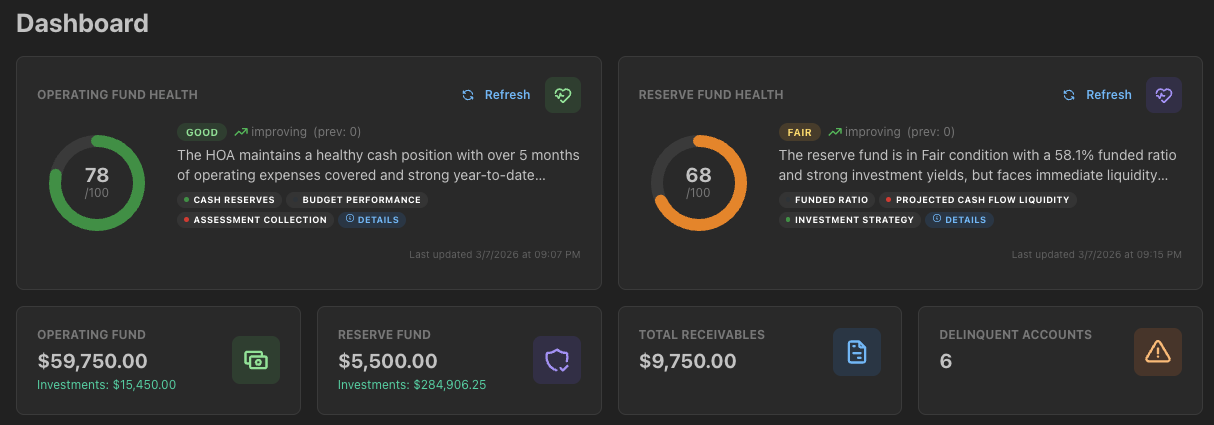
The reserve study landed in the board's inbox three weeks before the annual meeting, forty-one pages long, and the only number anyone actually discussed was on page six: "Percent Funded: 58%." The treasurer read it aloud. A homeowner in the back asked if that was bad. Nobody on the board could say for certain—was 58% a crisis, a mild concern, or perfectly normal for a fifteen-year-old community? The meeting moved on without an answer, and the number went back into a drawer until next year's study.
This scene repeats in HOA boardrooms constantly, and it's not because boards are careless—it's because the percent-funded score is one of the least understood numbers in community association finance. It sounds simple: reserves as a percentage of what they should be. But the number that produces that percentage, the assumptions behind it, and the right response to it are almost never explained to the volunteers who are supposed to act on it.
Understanding your reserve fund health score isn't about becoming an actuary. It's about knowing what the number is built from, what range you're actually in, and what specific action—if any—that range calls for. Once a board understands that, the percent-funded line stops being a mystery number read aloud once a year and becomes one of the most useful signals a community has.
What the Percent Funded Score Actually Measures
At its core, the percent-funded score is a ratio of two numbers: what your reserve fund actually holds today, divided by what it would hold if every component—roof, pavement, pool equipment, elevators, siding—had been funded in perfect proportion to how much of its useful life it has consumed. A roof that's ten years into a twenty-year life should, in a perfectly funded community, have roughly half its replacement cost sitting in reserves. Add that logic up across every reserve component and you get the "fully funded balance." Your actual balance divided by that number is your percent funded.
The number that trips boards up is the fully funded balance itself, because it's not a fixed target—it moves every year as components age, get replaced, or get re-estimated for cost. A community that contributes exactly the same amount every year can still watch its percent-funded score decline, simply because the fully funded balance grew faster than the fund did. That's not mismanagement. It's math. But without understanding this, a board can look at a declining percentage and panic, or look at a flat percentage and wrongly assume nothing needs attention.
"For years I thought percent funded was like a bank statement—if it went down, we'd spent too much. It took a conversation with our reserve specialist to understand it's really a comparison against a moving target. That changed how I read the number completely." — HOA Treasurer, Fort Collins, CO
Why 100% Funded Isn't Always the Right Target
Reserve specialists and community association institutes generally describe percent-funded ranges in three broad bands: below 30% is considered weak and carries meaningful special assessment risk; 30% to 70% is considered fair, adequate for many stable communities; and above 70% is considered strong. Very few well-run associations sit at 100%, and that's by design, not failure.
Chasing 100% funded means collecting assessments today for replacements that might be a decade away, which means homeowners are paying in advance for value they won't see for years—money that, in most cases, could be earning better returns elsewhere or easing the burden on current owners. A community sitting comfortably at 75% to 85% funded, with a reserve plan that shows contributions keeping pace with the fully funded balance over time, is often in a stronger practical position than a community rigidly targeting 100% at the cost of large annual increases.
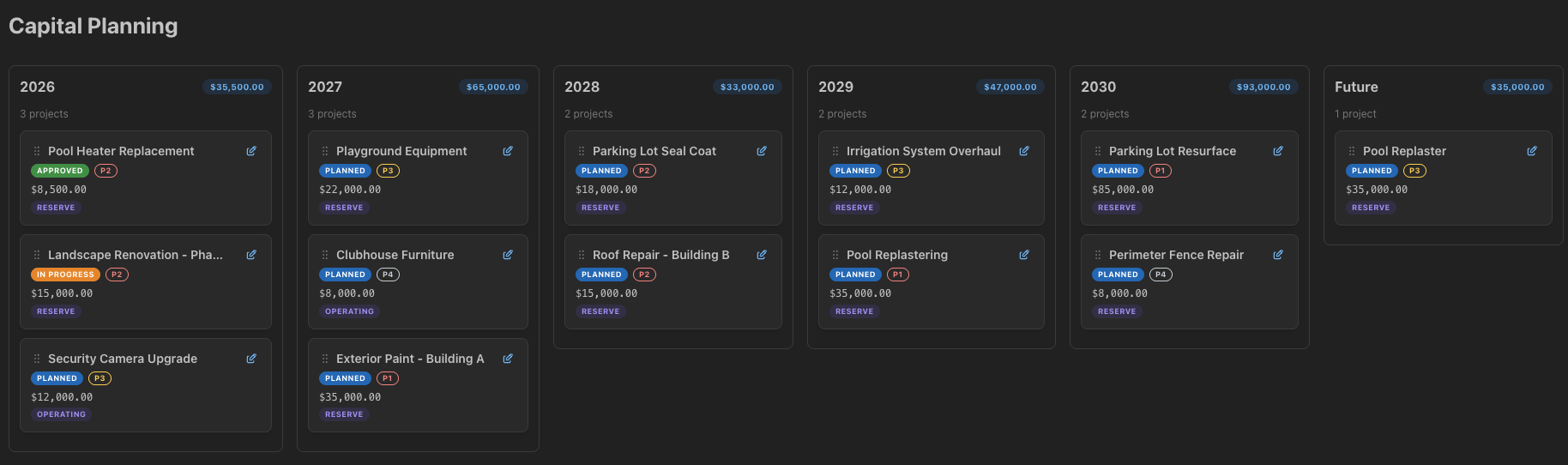
What actually matters isn't hitting a specific percentage—it's whether the trajectory is stable or improving, and whether the fund can absorb the community's largest near-term expense without a special assessment. A 68% funded community with a clear, funded plan for its next major project is in far better shape than a 74% funded community whose roof replacement is due in eighteen months and isn't accounted for in the number at all.
The Three Numbers Hiding Behind Every Health Score
A single percentage compresses a lot of information, and boards that only look at the top-line number miss the parts that actually predict trouble. Three numbers sit underneath every reserve fund health score, and each tells a different part of the story.
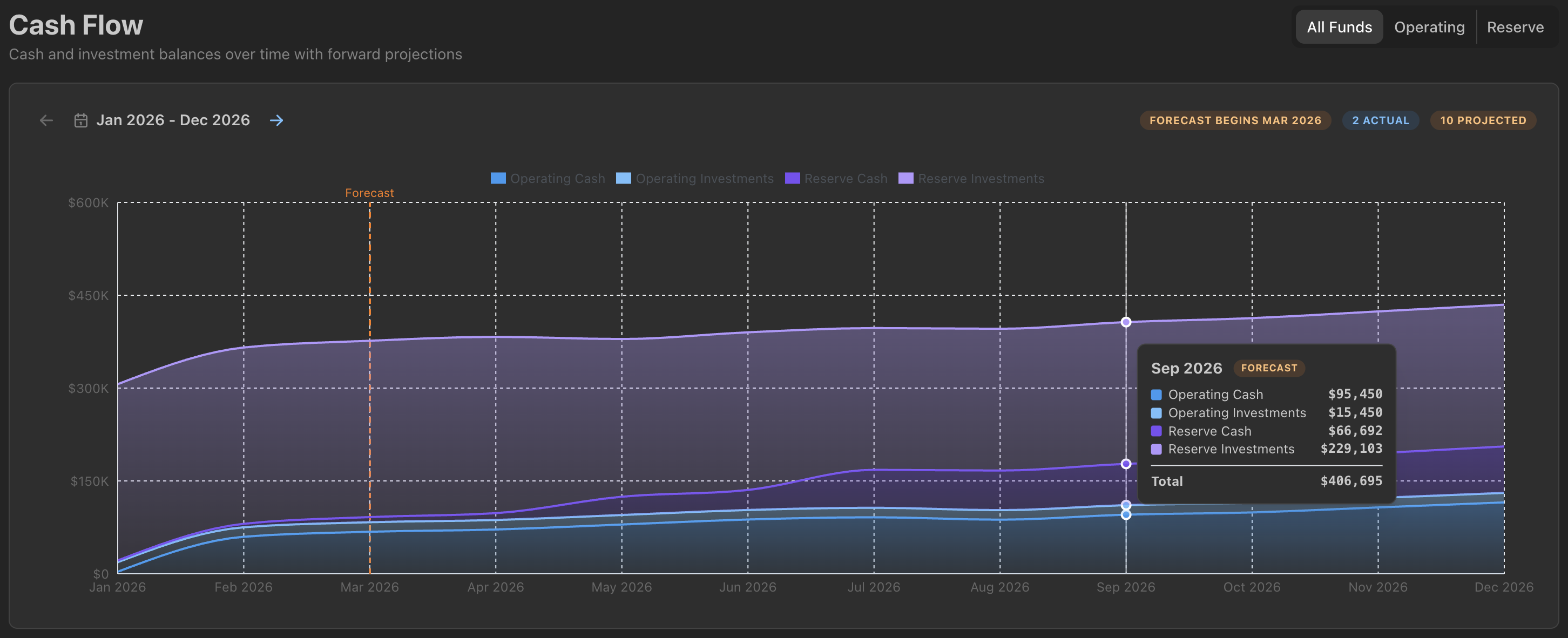
The first is the current balance—straightforward, the actual dollars sitting in the reserve account today. The second is the fully funded balance, the moving target described above. The third, and the one most boards never see broken out, is the funding threshold for the community's single largest near-term component. A community with $400,000 in reserves and a $380,000 roof replacement due in fourteen months has a very different risk profile than one with the same $400,000 balance and no major project for six years, even if their percent-funded scores land in the same range.
This is why a reserve study's appendix—the component-by-component funding table—often matters more than its summary page. It shows not just the aggregate percentage but which specific components are underfunded relative to their timeline. A board that only reads the cover page might feel reassured by a 65% overall score, unaware that the single component driving the community's next assessment risk is funded at 20%.
"We were sitting at 71% funded and felt fine. Then someone actually opened the component table and found our clubhouse HVAC system—due for replacement in two years—was funded at 12%. The overall number hid it completely." — HOA Board Secretary, Naples, FL
Reading the Trend, Not Just the Snapshot
A reserve study is typically produced once every three to five years, sometimes updated annually with a simpler desktop review in between. That cadence means most boards experience their percent-funded score as a series of disconnected snapshots rather than a continuous line—and a single snapshot, without context for where the number has been or where it's heading, tells you far less than it seems to.
A community that moved from 82% funded to 74% funded over three years is telling a very different story than one that's been steady at 74% for a decade. The first suggests contributions aren't keeping pace with rising replacement costs or newly identified components—a trend that, left alone, compounds. The second may simply reflect a community that has calibrated its funding policy to a sustainable, intentional level and is holding it there.
The boards that manage reserves well don't wait for the next formal study to check their trajectory. They track contributions against the funding plan every month, they revisit cost estimates when a vendor quote comes in meaningfully different from the reserve study's projection, and they treat the percent-funded number as a running conversation rather than a once-every-few-years report card. That shift—from event to habit—is often the single biggest difference between communities that avoid special assessments and communities that get blindsided by them.
What to Do When Your Score Is Low
A weak percent-funded score—generally under 30%, or trending down toward it—isn't a reason to panic, but it is a reason to act deliberately rather than reactively. The instinct in a lot of boardrooms is to either ignore the number until a crisis forces a special assessment, or to overcorrect with a dramatic assessment increase that homeowners resist and resent.
The more sustainable path is usually a multi-year glide plan: a defined schedule of gradual contribution increases, timed to close the gap before the community's largest project comes due, communicated to homeowners well in advance and tied explicitly to specific components rather than a vague appeal for "more money in reserves." Homeowners tolerate predictable, explained increases far better than sudden ones, and a board that can point to "this increase closes the gap on the roof fund two years ahead of the replacement date" earns far more trust than one that simply says reserves are low.
In some cases, a modest, planned loan or line of credit against future assessments—paired with a funding plan to repay it—is a more homeowner-friendly option than a lump-sum special assessment, spreading the cost over time rather than demanding it all at once. The right answer depends on the community's specific timeline and risk tolerance, but the wrong answer, in almost every case, is doing nothing and hoping the gap closes itself.
What This Looks Like in Practice
Sienna Ridge is a 140-unit townhome community outside Denver that came in at 41% funded on its 2024 reserve study—solidly in the "fair, trending toward weak" range, with a shared roof and gutter system due for replacement in five years at an estimated $610,000. The board's first instinct was to raise assessments significantly and get to 70% funded as fast as possible, but a closer look at the component table showed that wasn't actually necessary: the roof project was the only major near-term expense, and a steady five-year ramp in contributions would fully fund it right on schedule without a dramatic single-year jump.
The board built a five-year contribution schedule with modest annual increases—about 6% per year rather than one large jump—and presented it to homeowners with a simple visual showing exactly how the increases mapped to the roof project timeline. They also began tracking contributions against that plan every quarter instead of waiting for the next formal study, catching a small shortfall in year two when a vendor's updated estimate came in $40,000 higher than the original study projected, and adjusting the fourth-year contribution slightly to compensate.
By the time the roof project came due, Sienna Ridge had the full $610,000 in reserves, no special assessment, and a board that had spent five years explaining a clear, credible plan to homeowners rather than five years hoping the number would somehow resolve itself. Their percent-funded score at year five: 68%—still not 100%, and not meant to be, but exactly aligned with what their upcoming project timeline required.
"We used to treat the reserve study like a report card we didn't want to get. Now we treat the percent-funded number like a dashboard gauge—something we check often, understand, and can actually steer." — Sienna Ridge HOA Treasurer
The percentage on page six of your reserve study will keep getting read aloud at board meetings whether or not anyone understands it. The communities that avoid special assessments and homeowner backlash are the ones that stop treating it as a mystery number and start treating it as what it actually is: a running measurement of whether today's decisions are keeping pace with tomorrow's bills.