← Back to Insights

CD Laddering for HOA Reserve Funds:
A Practical Guide

Your reserve fund may be the largest pool of money your community will ever manage — and most of it is probably sitting in a checking account earning almost nothing. Here's the strategy that changes that.

Somewhere in your community's bank records, there's a reserve fund balance. Maybe it's $180,000. Maybe it's $650,000. Whatever the number, there's a good chance most of it is sitting in a standard checking or savings account — the same kind of account you might use for your personal grocery money — earning somewhere between 0.01% and 0.50% annually.

Meanwhile, certificates of deposit at FDIC-insured banks are paying 4% or better on terms as short as three months. The math on the difference isn't subtle. A $400,000 reserve fund earning 0.10% generates $400 a year in interest income. That same fund in a thoughtfully structured CD ladder earning an average of 4.5% generates $18,000 — every year — without taking on any meaningful risk and without locking up funds the community might need.

The reason most HOA boards don't capture this income isn't ignorance. It's uncertainty. Treasurers know the reserve fund exists to pay for capital projects, and they're understandably nervous about committing funds to instruments with fixed maturity dates when project timing is hard to predict. What if a roof fails early? What if the board decides to accelerate the parking lot? The precautionary answer — keep everything liquid — is safe but costly.

CD laddering is the strategy that resolves this tension. It preserves liquidity by staggering maturity dates across multiple instruments, so something is always becoming available, while capturing yields that a simple savings account can't touch. And for HOA reserve funds — which have long time horizons, predictable (if sometimes approximate) spending schedules, and no tolerance for investment risk — it's close to the ideal approach.

Why Reserve Fund Yield Matters More Than Most Boards Realize

There's a tendency to treat investment income on reserve funds as a nice bonus — something that happens in the background and occasionally shows up as a pleasant line item on the monthly report. In reality, it's a meaningful contributor to reserve fund health, and ignoring it has compounding consequences over time.

Consider two communities, each with $350,000 in reserves today, each contributing $4,000 per month. Community A keeps everything in a savings account earning 0.25%. Community B maintains a CD ladder earning an average of 4.25%. Over five years, the difference in interest income is roughly $68,000 — money that Community B can put toward capital projects, reducing the contribution rate increase needed in the next budget cycle, or simply building a larger cushion against unexpected costs.

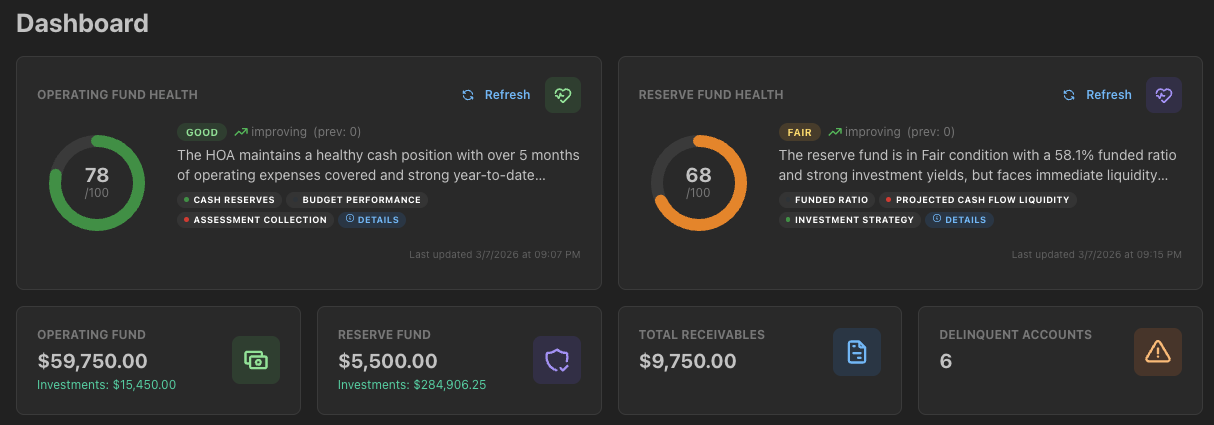
That gap has another implication that's less obvious but equally important: reserve fund health scores are forward-looking calculations that include projected investment income. A fund earning 4% annually on its balance is on track to fund its capital needs at a lower contribution rate than a fund earning 0.25% on the same balance. In other words, better investment management can directly reduce the assessment increases homeowners face — or provide the additional margin that prevents a future special assessment.

The compounding reality: Investment income on reserve funds isn't a rounding error. Over a 5- to 10-year horizon, the difference between idle cash and a properly laddered CD portfolio can easily exceed $50,000–$100,000 for a mid-size community — enough to meaningfully affect the reserve fund health score and the contribution rate required to maintain it.

What CD Laddering Is (And Why It Fits HOAs So Well)

A CD ladder is a portfolio of certificates of deposit with staggered maturity dates. Instead of putting all your available funds into a single 12-month CD and hoping nothing comes up before it matures, you divide the funds across multiple CDs with different terms — say, 3 months, 6 months, 9 months, 12 months, and 18 months. As each CD matures, you either spend the funds if they're needed for a project, or roll them into a new CD at the long end of the ladder.

The result is a structure where some portion of your reserve fund is always approaching maturity. If an urgent capital need arises, there's a CD coming due within a few months at most. If no projects are imminent, maturing CDs roll into new longer-term instruments, maintaining the yield. The ladder is self-renewing and continuously liquid in a practical sense — not liquid like a checking account, but liquid in the way that matters for capital project planning.

This structure maps onto HOA reserve fund dynamics unusually well for several reasons. First, reserve fund spending isn't random — it follows a capital project schedule with known (if sometimes approximate) timing. Second, the amounts involved are large enough that even modest yield improvements generate material income. Third, HOA reserve funds have an implicit multi-year time horizon, making longer CD terms readily available for the bulk of the portfolio. And fourth, FDIC insurance covers CD balances at insured institutions up to $250,000 per depositor per institution, making it possible to protect large reserve balances by distributing across multiple banks.

"We had $380,000 in reserves sitting in our operating bank's savings account earning almost nothing. Our treasurer built a five-rung ladder and we went from earning maybe $600 a year to over $16,000. That's basically a free parking lot reseal every five years just from interest income we were leaving on the table."
Building a Ladder: A Step-by-Step Approach

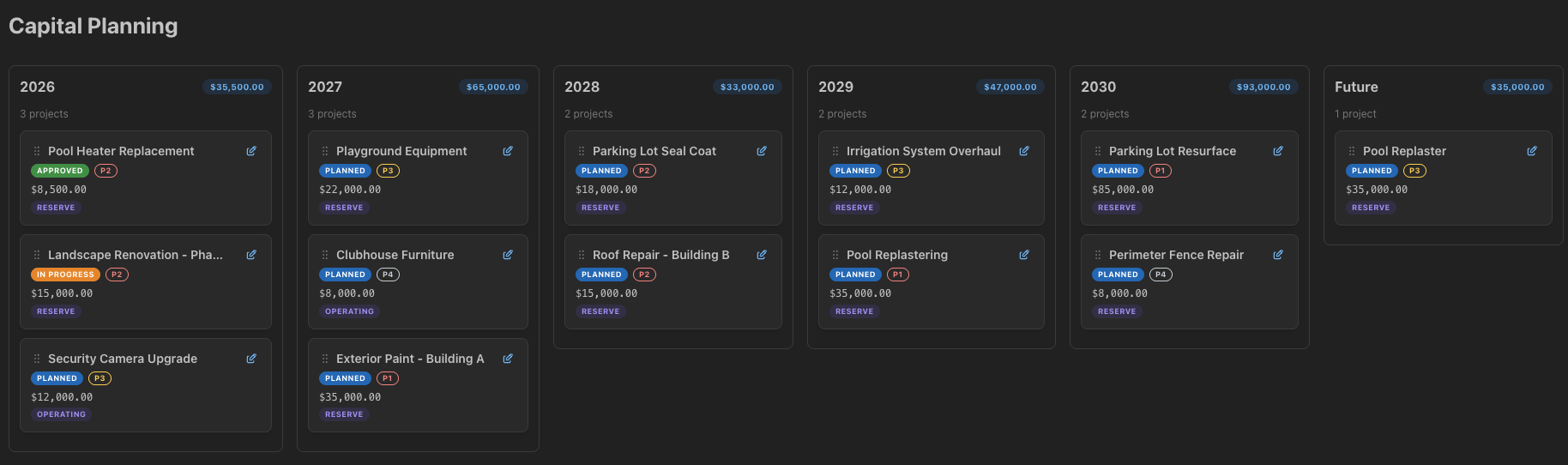
The mechanics of building a CD ladder for a reserve fund aren't complicated, but the starting point matters enormously: you need a reliable picture of your capital project timeline before you commit any funds to fixed-maturity instruments. The ladder is only as good as the cash flow forecast behind it.

Start by identifying your known capital projects for the next 24 to 36 months and the approximate amounts and timing of each. This becomes your liquidity reserve — the portion of the reserve fund you keep accessible, either in a high-yield savings account or in very short-term instruments (30-to-90-day CDs or T-bills). A reasonable rule of thumb is to keep 12 to 18 months of projected capital spending fully liquid. If you have $90,000 in projects expected over the next 18 months, keep at least that much outside the ladder.

Everything above that near-term liquidity buffer is a candidate for the ladder. Divide the remaining balance into roughly equal tranches — five rungs is a common structure — and place each in a CD with a different maturity date. A simple starting configuration might look like this:

A simple five-rung ladder example ($250,000 investable):

Rung 1 — $50,000 in a 3-month CD  ·  Rung 2 — $50,000 in a 6-month CD  ·  Rung 3 — $50,000 in a 9-month CD  ·  Rung 4 — $50,000 in a 12-month CD  ·  Rung 5 — $50,000 in an 18-month CD

As each rung matures, roll the proceeds into a new 18-month CD (or redirect to a project if needed). Within 18 months, all five rungs are at 18 months, maximizing yield while maintaining the built-in liquidity rhythm.2026 Note: Shorter term CD's currently have higher yields than longer term CD's at current time. HOA Ledger IQ's AI-Assisted Investment Engine automatically optimizes a suggested CD ladder strategy to take this into account, while allowing for planning to be adjusted over time as rate conditions change.

As you roll maturing CDs, shop rates across FDIC-insured institutions. Online banks and credit unions frequently offer meaningfully higher yields than the community's primary operating bank. The incremental yield difference between the best and worst rates available on a given day can be 0.5% to 1.0% — which on a $200,000 position represents $1,000 to $2,000 in additional annual income for no additional work.

The Cash Flow Timing Problem — and How to Solve It

The single biggest obstacle to HOA reserve fund investment isn't risk tolerance or board approval. It's uncertainty about timing. Treasurers who can't answer "when will we actually need this money?" default to keeping everything liquid, because that answer is always safe even if it's always costly.

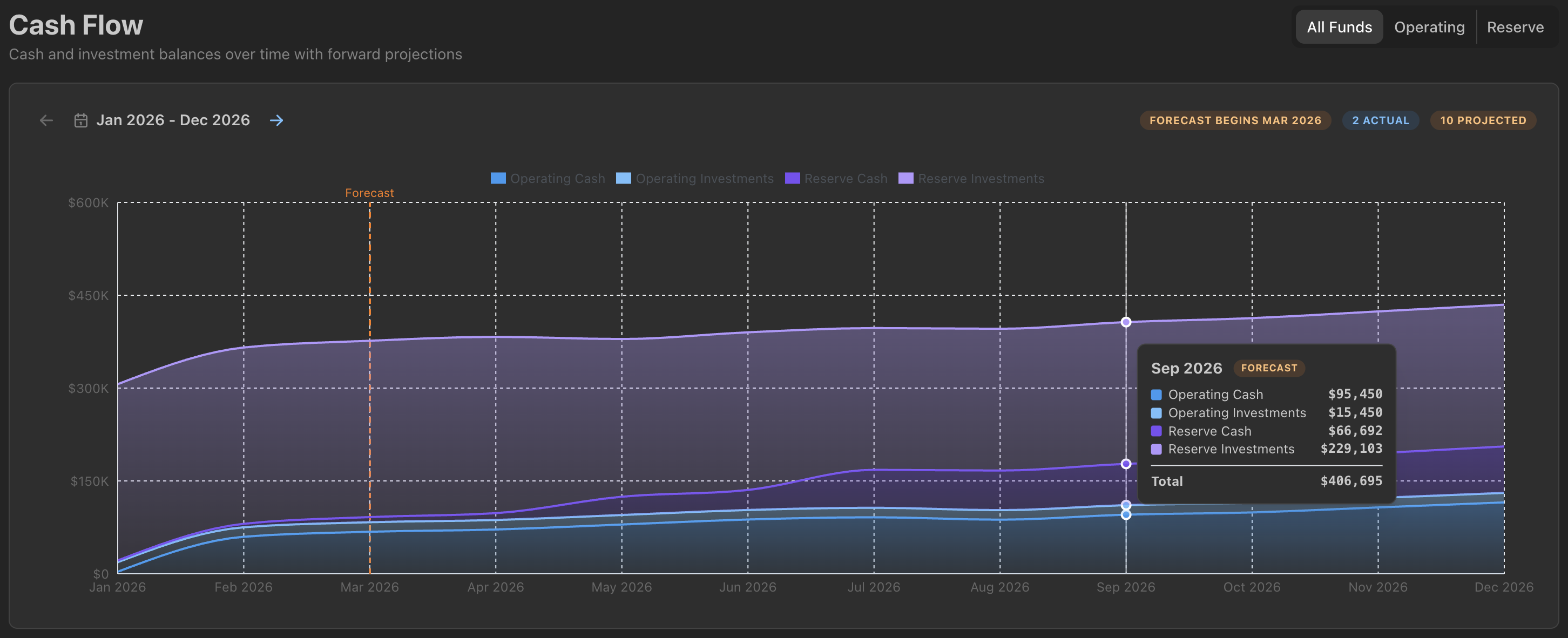
This is why cash flow forecasting and investment strategy are inseparable for HOA reserve funds. A board that knows with reasonable confidence that no major capital spending is expected in the next 14 months can commit funds to a 12-month CD without anxiety. A board operating with no forward visibility treats the same 12-month CD as a gamble — because anything could happen, and if it does, they'd face penalties for early withdrawal or have to scramble for alternative funding.

The practical implication is this: before any CD ladder can be built intelligently, the board needs a working capital project schedule with current cost estimates and realistic timing. Not a 2021 reserve study that's never been updated — an active, maintained view of what needs to happen and approximately when. That schedule becomes the foundation for every investment decision the treasurer makes.

When that schedule is maintained in a financial platform that continuously models it against the reserve fund balance, something useful happens: the treasurer can see exactly how much of the reserve fund is "needed" within any given timeframe, and how much is available for longer-duration investment. The ladder structure becomes a direct output of the cash flow model, rather than a guess made under uncertainty.

The key insight: CD laddering doesn't require predicting the future precisely. It requires knowing your capital project schedule well enough to identify which portion of your reserve fund won't be needed for 6, 12, or 18 months. Good cash flow tooling turns that from a nerve-wracking guess into a confident, data-backed decision.

Investment Planning Built Into Your Reserve Dashboard

Forward-looking cash flow projections, capital project timelines, and investment opportunity alerts — so your board always knows which funds can safely be put to work.

What This Looks Like in Practice

Consider a 160-unit condominium association with $420,000 in reserve funds. Their capital project schedule shows one significant project in the pipeline: a pool deck resurfacing estimated at $55,000, expected in about 14 months. Beyond that, no major spending is projected for at least three years — the elevator modernization isn't until 2030, and the roof still has a solid remaining useful life.

The treasurer, working from a current cash flow projection, identifies the investable picture: $55,000 needs to stay accessible for the pool project (she keeps $70,000 liquid with a small buffer), leaving $350,000 for the ladder. She builds a five-rung structure: $70,000 in a 3-month CD, $70,000 in a 6-month CD, $70,000 in a 9-month CD, $70,000 in a 12-month CD, and $70,000 in an 18-month CD. She shops rates across four FDIC-insured online banks and lands average yields just above 4.6%.

Annual interest income on the laddered portion: approximately $16,100. The prior year, with everything in the association's operating bank savings account at 0.30%, the same $350,000 generated about $1,050. The difference — $15,050 in additional annual income — is roughly equivalent to $8 per unit per month in assessment value. It doesn't replace the contribution rate, but it meaningfully improves the reserve fund health trajectory without asking homeowners for a dollar more.

Fourteen months later, the pool project moves forward. The 3-month CD matured at the three-month mark and was rolled into an 18-month CD. The 6-month CD matured and was also rolled. When the project is ready to begin, the treasurer directs the proceeds of the maturing 12-month CD toward the contractor payment — exactly as planned, with no early withdrawal, no penalties, and no scrambling. The remaining three rungs continue compounding.

A Strategy Worth the Half-Day It Takes to Set Up

CD laddering is one of those financial strategies that sounds more complicated than it is. In practice, building a five-rung ladder takes a few hours: pulling your project schedule, identifying the investable portion, shopping rates at a handful of institutions, and opening the CDs. Annual maintenance is minimal — reviewing each maturity, deciding whether to roll or redirect, updating the ladder structure if the project timeline shifts.

The return on that half-day's work, for a community with a meaningful reserve balance, can be tens of thousands of dollars over a five-year period. It doesn't require financial expertise, stock market exposure, or any risk tolerance beyond what's already implied by keeping money in an FDIC-insured bank account. It just requires knowing your capital project timeline well enough to commit a portion of your reserves to time-locked instruments with confidence.

That confidence — knowing when your community will need its money and when it won't — is what modern HOA financial platforms are built to provide. When your reserve fund health score, cash flow projections, and capital project schedule are all visible in one place and updated continuously, the investment strategy practically writes itself. The question stops being "is this safe?" and starts being "how much yield are we leaving on the table by not doing this?"

For most HOA reserve funds, the honest answer to that second question is: quite a lot. And that's worth fixing.

Know Exactly Which Funds Can Work Harder.

HOA LedgerIQ's forward cash flow projections and capital planning tools give your board the visibility to invest reserve funds confidently — and stop leaving interest income on the table.

Start Your Free 14-Day Trial

No credit card required  ·  14-day free trial  ·  No contracts

← Previous: HOA Budget Season Guide All Insights →