← Back to Insights

5 Financial Blind Spots Putting Your HOA at Risk
(And How HOA LedgerIQ Finds Them)

Most boards don't know what they don't know. Spreadsheets don't send alerts. Static reports don't forecast. Here's what's hiding in plain sight.

Picture this: It's 48 hours before your HOA's quarterly board meeting. Your treasurer has just discovered that the reserve fund balance is off from where the spreadsheet said it should be. Two homeowners went delinquent two months ago — but nobody noticed until now because the tracking was buried four tabs deep. And someone just forwarded an email from a vendor asking why the landscaping invoice hasn't been paid, because the budget line ran out in September.

Welcome to the reality of manual HOA financial management.

The hard truth is that most HOA boards don't know what they don't know. Not because they're careless — quite the opposite. It's because the tools most boards use were never designed to surface problems proactively. Spreadsheets don't send alerts. Static reports don't forecast. Manual processes create lag between when a problem starts and when someone finally sees it.

The result? Financial blind spots that quietly cost communities tens of thousands of dollars — often before anyone realizes there's a problem at all.

Here are the five most common financial blind spots affecting HOA boards today, and how our AI-enabled management platform is eliminating them before they become crises.

Blind Spot #1: Cash Flow Amnesia

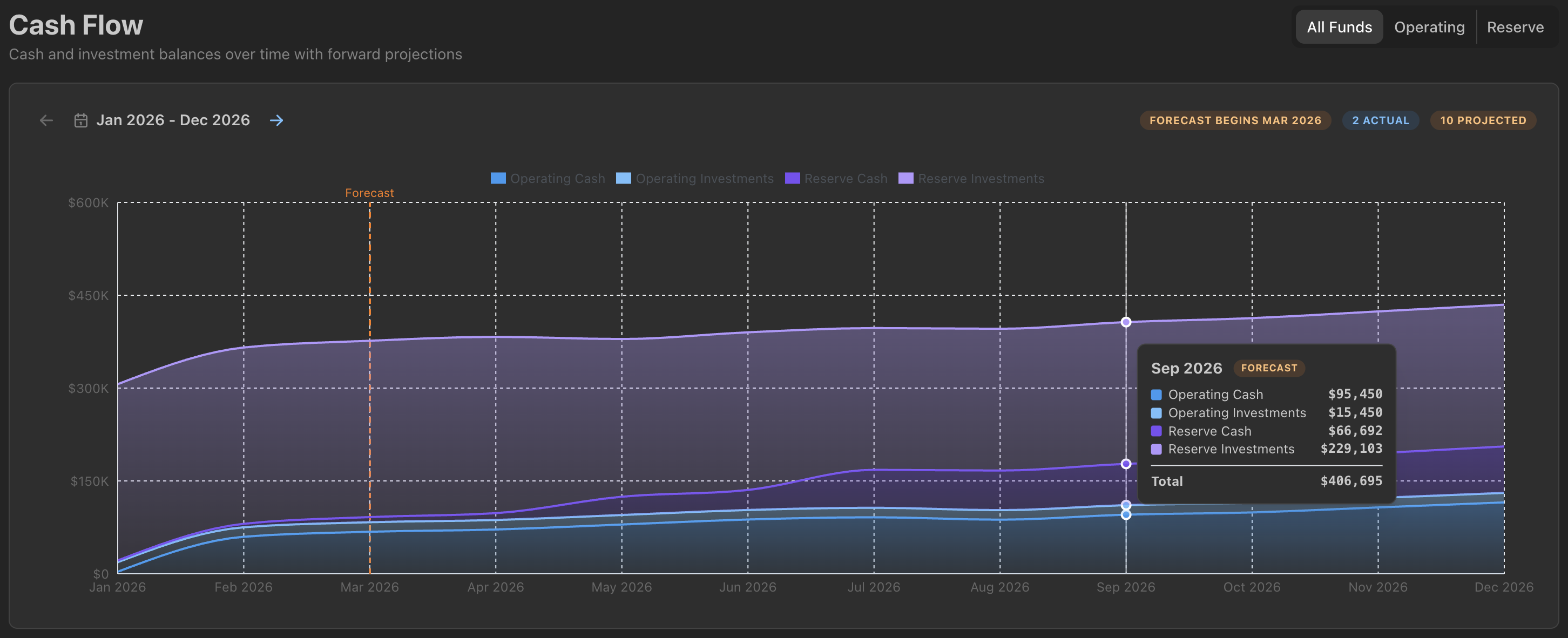
Most treasurers know their current bank balance. Very few can accurately answer: "What will our balance be in 90 days?"

This distinction matters enormously. A $150,000 balance today can look perfectly healthy — right up until you remember that $80,000 in landscaping contracts comes due next month, $35,000 in insurance renewal hits in 60 days, and the quarterly reserve contribution is $25,000. Suddenly, that healthy-looking balance is a cash crisis in slow motion, and nobody has sounded the alarm because the spreadsheet only shows what's already happened.

Traditional financial tracking is backward-looking by nature. It tells you where you've been, not where you're going. AI-powered cash flow forecasting changes this entirely, modeling your projected balance 12 or more months into the future — based on known expense patterns, assessment income timing, seasonal spending cycles, and scheduled capital projects.

What HOA LedgerIQ finds: Cash crunches before they happen, giving boards time to adjust project timing, optimize investment placement, or accelerate assessment collection — instead of scrambling when the account runs dry.

Blind Spot #2: Reserve Fund False Confidence

"We have reserves" and "we have enough reserves" are very different statements. On a spreadsheet, they can look identical.

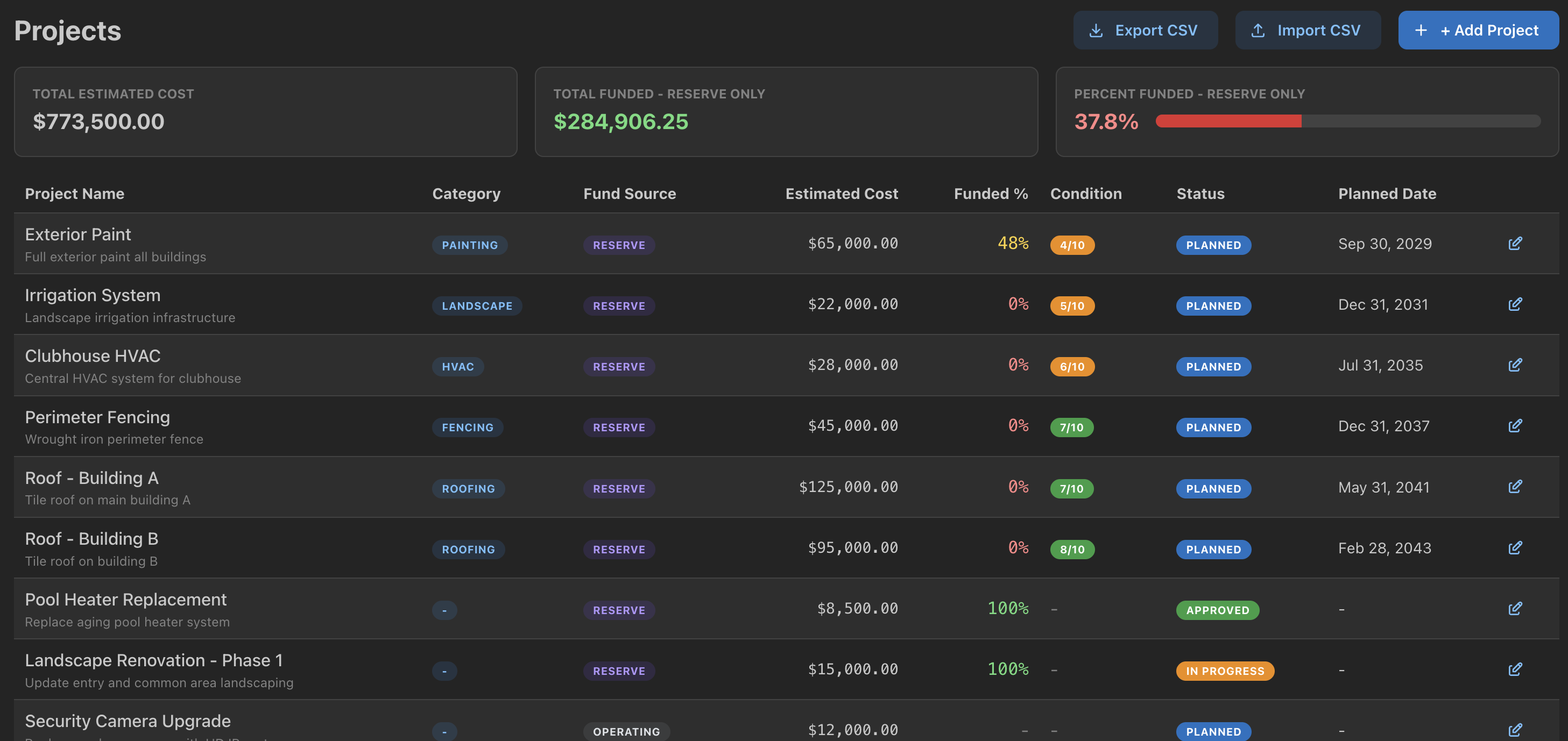
This is one of the most dangerous blind spots in HOA finance. A community might have $500,000 in their reserve account and feel financially secure. But without modeling that balance against the actual schedule of upcoming capital needs — roof replacement, HVAC systems, parking lot resurfacing, elevator modernization, pool equipment — it's impossible to know whether $500,000 is a cushion or a shortfall in disguise.

Reserve studies are supposed to solve this, but they have a critical structural flaw: they're static. The moment a reserve study is published, it begins going out of date. Actual spending differs from projections. Interest rates shift. Material costs change. Project timelines slip. A study completed in 2022 may be meaningfully misleading by 2026.

HOA LedgerIQ reserve tracking makes this a living, continuous process. It compares actual reserve fund contributions and balances against the schedule of upcoming capital needs in real time, generating a health score that updates as conditions change — not just when someone remembers to update the spreadsheet.

What HOA LedgerIQ finds: Reserve shortfalls 12 to 24 months before they become emergencies, giving boards time for corrective action — an adjusted contribution rate, a modest assessment increase — rather than a surprise special assessment that leaves homeowners furious and the board scrambling.

Blind Spot #3: Investment Income Left on the Table

Here's a question worth asking right now: how much of your community's operating cash is sitting in a non-interest-bearing account?

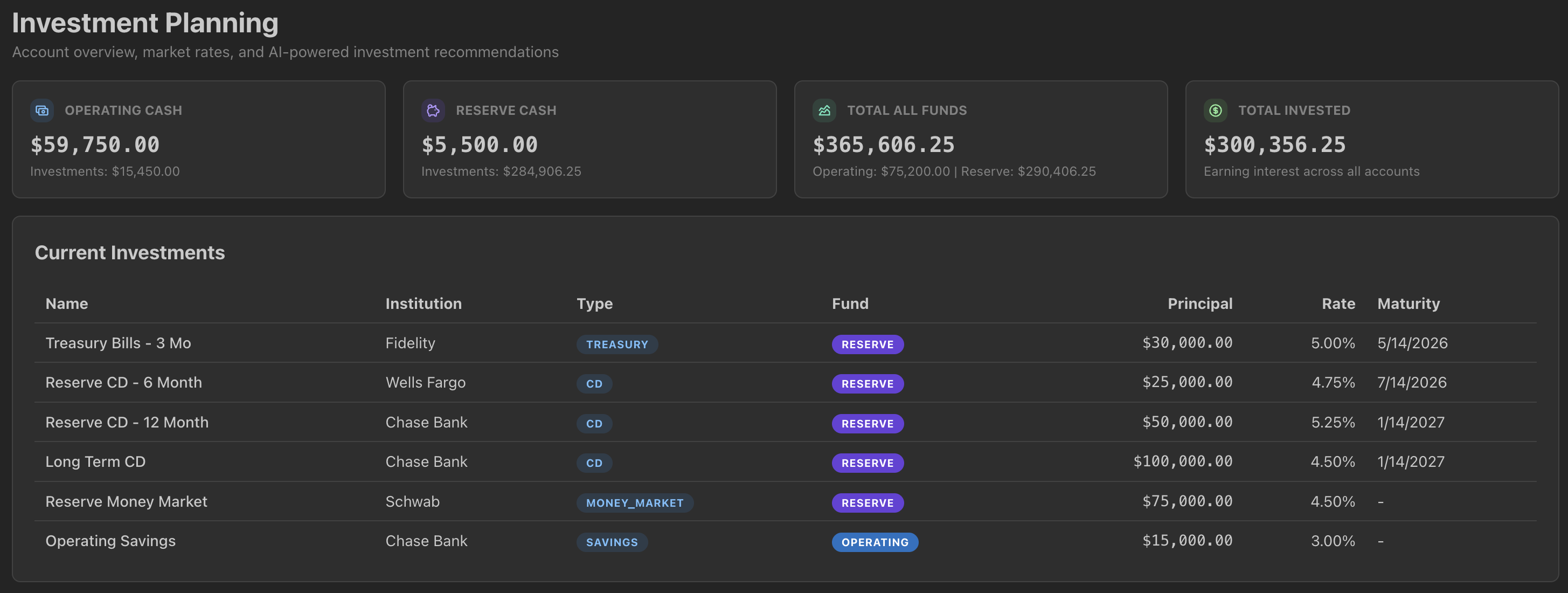
For many HOAs, the answer is: most of it. Operating funds that aren't needed for immediate expenses tend to sit idle in basic checking accounts, earning nothing — while even modest deployment into high-yield savings, money market funds, or short-term CDs could be generating meaningful income for the community.

The hesitation is understandable. Deploying operating funds into any investment requires confidence that those funds won't be needed for expenses in the near term. Without reliable forward-looking cash flow projections, most treasurers keep everything liquid as a precaution — even when a meaningful portion could safely be put to work.

HOA LedgerIQ changes this calculus. By modeling projected cash needs against current balances, it can identify windows where idle funds can be safely deployed — and recommend specific strategies based on the timing and amount: a 30-day CD here, a 90-day treasury there, a sweep into a money market account while the next assessment cycle loads up.

What HOA LedgerIQ finds: Opportunities to earn additional investment income on idle funds — often thousands of dollars per year that most boards are simply leaving on the table without realizing it.
Blind Spot #4: Delinquency Detection Lag

Assessment delinquencies are a fact of life for every HOA. What separates well-run communities from struggling ones is how quickly they detect and respond to them.

In manual tracking environments, delinquencies frequently go undetected for 60 to 90 days. By the time a treasurer notices the discrepancy while reconciling a bank statement, confirms it in the spreadsheet, and raises it at the next board meeting — weeks or months have passed. The delinquent homeowner is now significantly deeper in arrears, recovery becomes harder, and the community's cash flow has quietly taken a hit that's rippling through the budget.

Automated delinquency tracking monitors payment patterns continuously. When a homeowner misses a payment — or when a pattern suggests a payment arrangement is deteriorating — the system flags it within days, not months. That speed matters. Early outreach often leads to quick resolution. A homeowner who's two weeks late and gets a friendly reminder is very different from one who's 90 days late and has now received a formal collections notice.

What HOA LedgerIQ finds: Payment issues in days rather than months, giving boards the opportunity to reach out early, offer payment plans when appropriate, and prevent small cash flow disruptions from compounding into significant arrears situations.

Blind Spot #5: Budget Variance Surprises

Nobody likes discovering at year-end that a budget line item ran 60% over projection. But in manual management environments, that's often exactly how boards find out.

The reason is simple: tracking budget-vs.-actual performance requires ongoing, active effort. In a spreadsheet-based system, that means someone has to manually pull current data, compare it against the approved budget, and calculate variances. This typically happens monthly at best, quarterly in many communities. By the time a significant variance is noticed, multiple months of overspending have already accumulated — and the options for corrective action have narrowed considerably.

Continuous variance monitoring turns this from a periodic manual exercise into an always-on alert system. When any budget category starts trending outside its approved range, the system flags it in real time — giving the board the opportunity to investigate and course-correct while there's still room to do so, not after the damage is done.

What HOA LedgerIQ finds: Budget deviations early in their development, when a conversation with a vendor or a simple spending adjustment can fix the problem — not at year-end when the overage is locked in and the only option is an unplanned reserve transfer.

How HOA LedgerIQ Eliminates the Blind Spots

Real-time dashboards, forward-looking forecasts, and AI-powered alerts — built to surface issues before they surface at a board meeting.

The Common Thread

Notice what all five of these blind spots have in common: they aren't failures of intelligence or diligence. They're failures of timing.

By the time manual processes surface these issues, the window for proactive response has often already closed. The cash shortage arrives before the forecast did. The reserve shortfall becomes visible when it's too late for gradual adjustment. The delinquency compounds for months before the spreadsheet reveals it. The budget variance is discovered after the fiscal year has ended.

AI-powered financial management doesn't just automate the tracking — it changes the when of discovery. From "too late to act" to "early enough to make a difference."

What This Looks Like in Practice

Consider a 200-unit HOA that switches from spreadsheet-based management to a platform like HOA LedgerIQ.

In the first month, the system flags that operating funds have been sitting idle in a non-interest-bearing checking account. Based on the cash flow model, $60,000 can be safely moved into a 90-day CD without affecting the community's ability to meet its obligations. At current rates, that's roughly $900 in additional interest income for the quarter — small in isolation, but meaningful when compounded year over year.

At month three, the reserve fund health score dips from 94% to 87%. The AI traces the change to a deferred HVAC replacement that's been rescheduled earlier than originally modeled. The board adjusts contributions by $50 per unit per month starting the following quarter. No emergency meeting. No special assessment. No angry homeowners.

At month five, a delinquency alert fires on a unit that's missed two consecutive payments. The board treasurer reaches out within the week, learns about a temporary hardship situation, and arranges a payment plan. The arrears are resolved within 90 days. Compare that to discovering a 6-month delinquency in December while closing out the books.

None of these outcomes required a financial expert on retainer. They required a system that was paying attention — so the board didn't have to do it manually.

Seeing Clearly

Financial blind spots don't just cost communities money. They cost board members sleep. They cost treasurers confidence. They cost volunteers the sense that their work actually matters — because how can you feel good about the financial health of your community when you're not entirely sure what that health actually is?

AI-powered HOA financial management doesn't eliminate the complexity of running a community association. What it does is ensure that the system is always watching, always modeling, and always surfacing the issues that matter — early enough for boards to respond, rather than react.

That's not just better financial management. That's the peace of mind that makes volunteer board service actually sustainable.

Stop Flying Blind. Start Your Free Trial.

HOA LedgerIQ is accepting early access users now. See your community's financial blind spots — before they cost you.

Get Early Access

No credit card required  ·  14-day free trial  ·  No contracts

← Previous: Why We Built HOA LedgerIQ All Insights →